

Law firm intake: answer every call and book the consult on the first call
Key takeaways
- Run the intake math: monthly new-case calls x missed rate x close rate x average fee. In the example, 200 x 25% x 8% x $6,000 is $24,000 in fees lost a month.
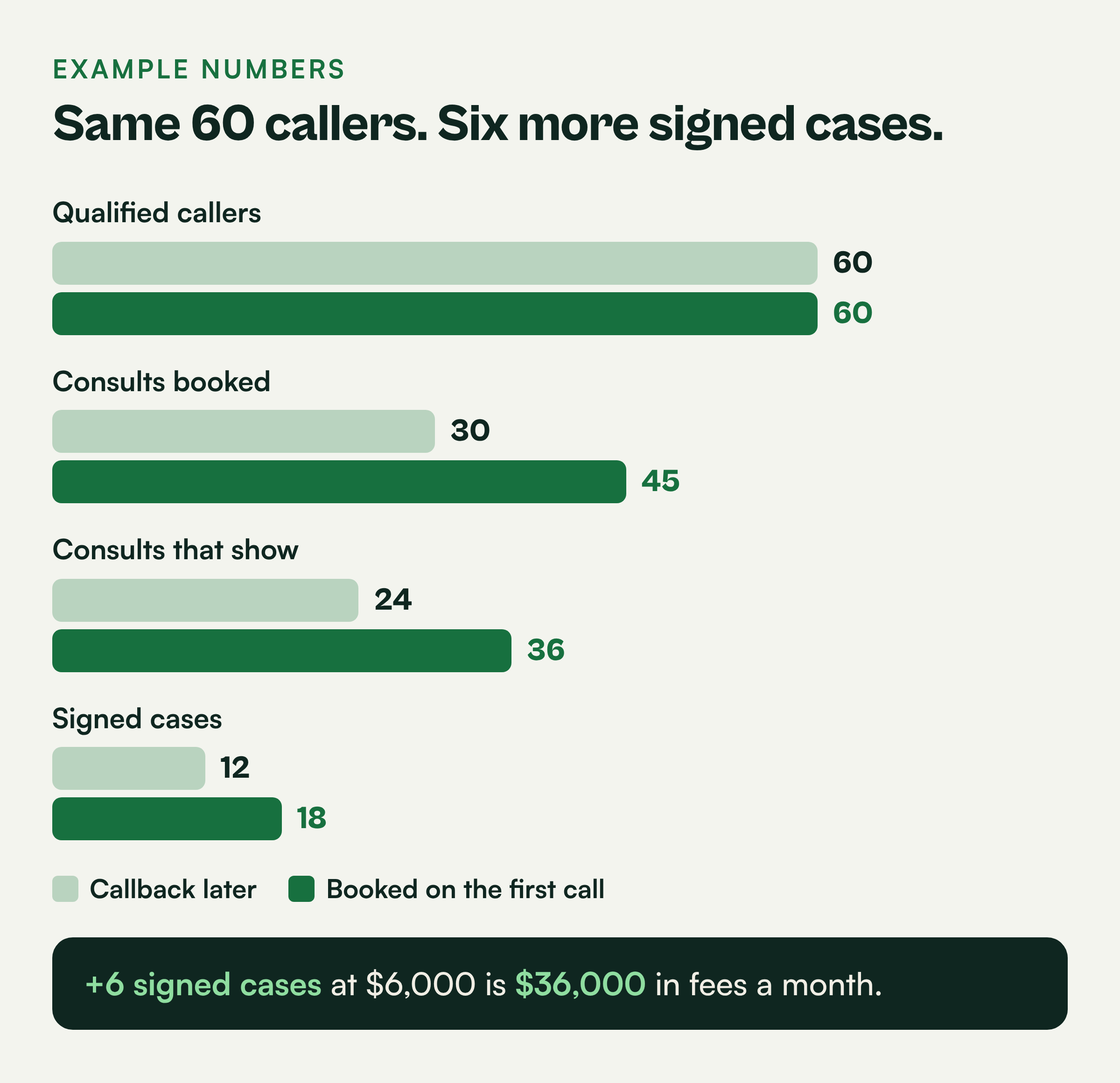
- Book the consult on the first call. In the example, that alone adds six signed cases a month from callers the firm already had on the phone.
- Cover the hours your ads run. In ClaireAI's after-hours test, 41% of personal injury firms never answered a call placed after 5 p.m.
- Track five numbers every Monday, led by the share of qualified callers booked on the first call.
- Fix intake before you raise the ad budget, and export your Local Services Ads reports before LSA moves into Google Ads.
Law firm intake is the process that turns a call, form or chat into a booked consultation and a signed client. Most firms lose cases in two places: calls nobody answers, especially after 5 p.m., and qualified callers told to wait for a callback. Answer every call live and book the consult on the first call.
Before I look at a law firm's ad account, I call its main number after 6 p.m. as a new client.
At a lot of firms, nobody answers. When someone does, the call usually ends with "an attorney will call you back tomorrow."
Both endings lose the case. The caller hangs up and dials the next firm on the list, and the money that made the phone ring is already spent.
Law firm intake is the step between the first ring and the signed fee agreement, and it is where most firms lose the cases they paid for. Two pieces of 2026 research point at the same leak:
- Smith.ai's Legal Intake Report on more than 3 million law firm calls found that booking the consultation during the first contact is the biggest lever firms aren't using, according to LawNext's coverage.
- ClaireAI's after-hours test of 1,000 personal injury firms found that 41% never answered a call placed after 5 p.m.
Both studies come from companies that sell intake services. Treat them as a direction, then check your own phones.
The fix is two rules. Answer every new-case call live at every hour your ads run, and end every qualified call with a consult on an attorney's calendar. The first step takes one evening: call your own line after hours, then count last month's missed new-case calls in your phone system.
Run the intake math on your own calls
Take an example firm. It spends $15,000 a month on marketing, the phones ring with 200 new-case calls, and each of those calls costs $75 to bring in.
Its phone report shows 25% of those calls rang out or went to voicemail. That is 50 callers and $3,750 of the month's spend that never reached a person.
What an owner needs to know is what those missed calls are worth in fees. The calls intake does answer sign at 8%, and if the missed callers would have signed at the same rate, the math looks like this:
200 calls x 25% missed x 8% close rate x $6,000 average fee = $24,000 in fees a month.
Over a year, that is $288,000 from one leak, before anyone changes the ads.
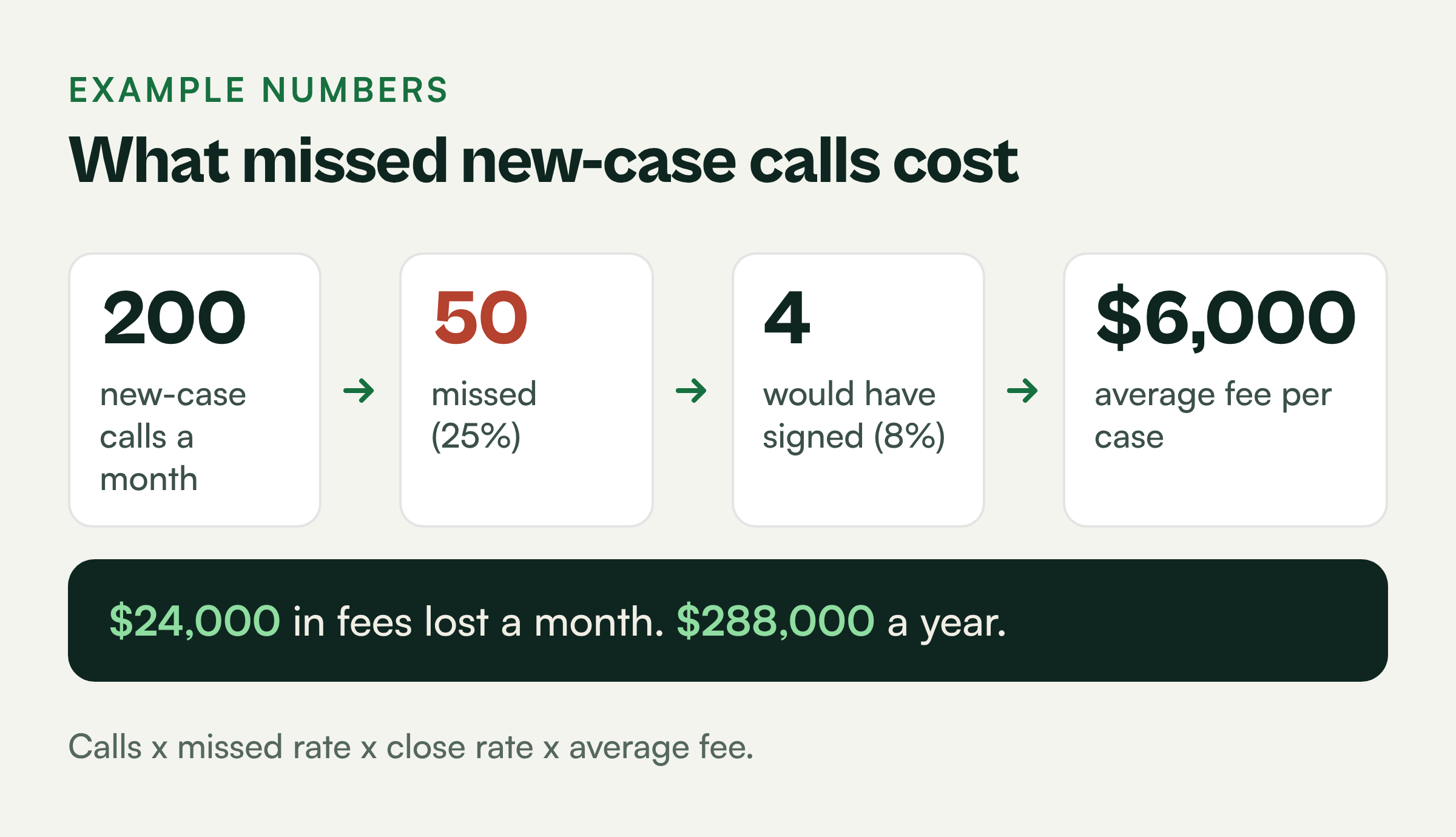
This is the first math I run when I look at a firm's intake, and it takes four numbers from your own systems. Monthly new-case calls and the missed rate come from your phone system or call tracking. Close rate and average fee come from Clio, MyCase, Filevine or whatever holds your signed matters.
If you can't separate new-case calls from existing clients and opposing counsel, that is the first thing we fix. A dedicated new-client number on your website and ads solves most of it.
Book the consult before the caller hangs up
The same example firm answers 150 calls a month. On the qualified ones, intake takes the details and ends the call with "we'll call you back."
By the time the attorney calls, the caller has booked with another firm. That is the second leak, and it happens on calls intake already answered.
| Step | Callback model | Booked on first call |
|---|---|---|
| Qualified callers (40%) | 60 | 60 |
| Consults booked | 30 (50%) | 45 (75%) |
| Consults that show (80%) | 24 | 36 |
| Signed (50% of consults) | 12 | 18 |
These are example numbers. Six more signed cases a month at $6,000 is $36,000 in fees from callers the firm already had on the phone.
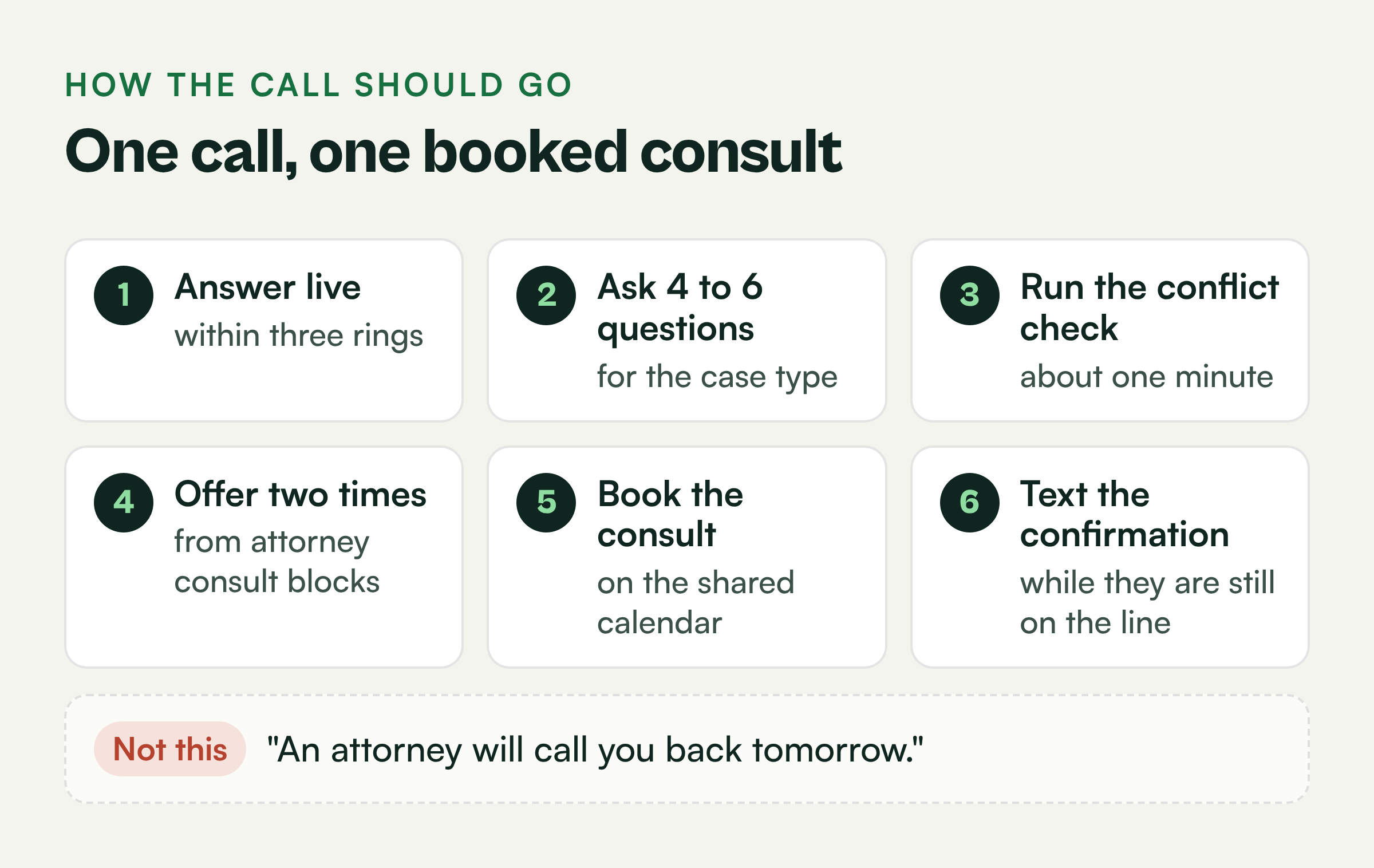
When I set up first-call booking at a firm, I put three things in place:
- Open consult slots intake can see. Each attorney blocks consult times on a shared calendar in Clio, Lawmatics or your scheduling tool, and intake books into them without asking first.
- A conflict check that takes a minute. Intake asks for the names of the other parties and runs them before booking.
- A confirmation text sent while the caller is still on the line, with the time, the address or video link, and what to bring.
Cover the hours your ads run
A DWI arrest happens at 1 a.m. A crash victim calls from an urgent care waiting room at 8 p.m. Injury, arrest and custody calls come at night and on weekends.
If your ads run around the clock and your phones stop at 5 p.m., you are paying for calls nobody picks up. ClaireAI's test found answer rates from 100% in San Antonio down to 36.5% in Detroit, and no region cleared 80%.
To cover nights and weekends, we choose between three common options, and the first thing I check is whether the person answering can book a consult on the call:
| Option | Who answers | Can book on the call | Watch for |
|---|---|---|---|
| In-house evening shift | Your intake staff | Yes | Gaps on sick days and holidays |
| Legal answering service | Operators on your script | Only with calendar access | Some only take messages |
| AI intake with a human backstop | AI agent, live transfer for urgent calls | Yes, if connected to your calendar | Test it on your case types first |
LawNext's coverage of the Smith.ai report says hybrid AI and human intake can perform well at lower cost. If you run on Clio, its Grow AI agent answers inquiries and follows up on unfinished intake forms and unsigned agreements after hours, according to Law.com's coverage of ClioCon 2026.
Budget after-hours coverage next to your ad spend. In the example firm, the missed calls were worth $24,000 a month in fees. Price each option against that number.
Fix intake in this order
When intake comes up, the instinct is to start with a new script or a new answering service. Without the call data, that fixes the step that feels worst, which may not be the one losing the most cases.
This is the order we work in. Measuring comes first because it shows which step matters most at your firm, and it catches problems that only look like intake, like the switched-off campaigns in the field notes above.
- Measure the leak. Pull 30 days of calls from your phone system or call tracking. Count new-case calls, missed calls, voicemails, and calls that ended with a booked consult.
- Answer every call live. During business hours, an unanswered call rolls to a second person after three rings instead of voicemail.
- Cover nights and weekends. Pick one option from the table above and run it for 30 days.
- Give intake the calendar. Attorneys hold consult blocks every weekday, and intake books into them.
- Rewrite the script around the booking. Ask four to six qualifying questions for the case type, run the conflict check, then offer two consult times. Cut questions the attorney will ask again in the consult.
- Call back web forms and chats within five minutes during business hours, and offer a consult time on that call.
- Chase no-shows the same day. A missed consult gets a call and a text within an hour, with two new times.
Put one person's name next to each step. If nobody at the firm owns signed cases from the first call to the fee agreement, decide who should run marketing at your firm first.
Track five intake numbers every week
Most intake teams can tell you how busy the phones were last week. Far fewer can tell you how many of those callers hung up with a consult on the calendar.
Without that, a slow month looks like a marketing problem even when the cases dropped out between the first ring and the fee agreement. Every Monday, we review five numbers with whoever runs intake, and they show where the cases drop out.
| Number | How to count it | Example firm, before and after |
|---|---|---|
| Answer rate | New-case calls answered live, divided by all new-case calls | 75% to 100% |
| Booked on first call | Qualified callers booked during the call, divided by all qualified callers | 50% by callback to 75% on the call |
| Show rate | Consults held, divided by consults booked | 80% to 80% |
| Signed rate | Fee agreements signed, divided by consults held | 50% to 50% |
| Cost per signed case | Marketing spend, divided by signed cases from marketing | $1,250 to $625 |
These are example numbers. With every call answered, 200 calls give 80 qualified callers. Booking 75% of them on the call gives 60 consults, 48 shows and 24 signed cases. The same $15,000 a month signs 24 cases instead of 12.
If your real result is half that gain, 18 cases, cost per signed case still drops from $1,250 to $833.
Cost per signed case only holds up when signed cases trace back to a campaign, which is why the click ID work in the field notes above belongs next to these five numbers.
Lead with the share of qualified callers booked on the first call. It is the lever the Smith.ai report points to, and most firms have never measured it.
Get your Local Services Ads ready for Google Ads
If your firm runs Local Services Ads, you pay for every lead, so a lead intake fumbles costs the same as one it signs.
That setup is changing. Google is moving LSAs into the main Google Ads interface as a pay-per-lead Performance Max campaign type, as Search Engine Land reports. The first wave started in August 2026 with home and storefront service businesses, and agency write-ups say legal accounts have no confirmed date yet.
Some of your LSA history will not make the move, and LSA calls need to stay visible once they share an account with your search ads. Before a migration notice arrives, we do three things:
- Export your LSA lead and performance reports. Lead history moves over, but historical performance reports do not.
- Decide who runs LSA once it sits in the same account as your search ads: your PPC agency or the person who handles it today.
- Tag LSA calls as their own source in your intake software, so cost per signed case from LSA stays visible after the move.
Fix intake before you raise the ad budget
When cases slow down, the usual first move is a bigger ad budget. More spend sends more calls into the same intake, so if 25% of calls ring out today, a bigger budget mostly buys more missed calls.
That is why we fix intake first. Once answer rate and first-call booking hold steady for 60 days, use the practice area ranking in our law firm marketing strategy guide to decide where the next dollar goes.
This matters most where calls come at night: personal injury marketing, criminal defense marketing and DWI.
Intake is the first thing I check when a firm brings us in as its fractional CMO for law firms. I have managed $500M+ in marketing spend over 15+ years, including for a law firm that grew from 1 location to 7 and is still growing (more about me and the team).
If you want the fix planned and sequenced, the Marketing Impact Roadmap builds it in about four weeks, from $10,000. To see how intake ranks against the rest of your marketing, score your firm's marketing for free.
Questions owners ask
What is the legal intake process?
It is every step from a prospective client's first contact to a signed fee agreement: answering the call or form, asking qualifying questions, running a conflict check, booking the consultation, holding it and sending the agreement. The step most firms skip is booking the consultation during that first call.
How fast should a law firm respond to a new lead?
Phone calls should get a live answer at every hour your ads run, including nights and weekends. Web forms and chats should get a call back within five minutes during business hours, with a consult time offered on that call. A caller who waits often hires the next firm on the list.
Should a law firm use an answering service or AI for after-hours intake?
Use whichever option can book a consult on the call, since a message for tomorrow loses many of the callers. An in-house evening shift, a legal answering service with calendar access, or AI intake with live transfer to a person can all work. Test it by calling your own line after hours before you rely on it.
What is a good intake conversion rate for a law firm?
There is no single benchmark, because it changes with practice area, case value and how qualified the calls are. Measure each stage on its own: answer rate, booked on first call, show rate and signed rate. Then improve the weakest stage against your own baseline.
How do I find out how many calls my law firm misses?
Pull 30 days of call logs from your phone system or call tracking tool and count new-case calls that rang out or went to voicemail. Then call your own number after 5 p.m. and on a Saturday. Together they show the missed rate and what a caller hears when nobody picks up.